The international project Science Comes to Town officially opened
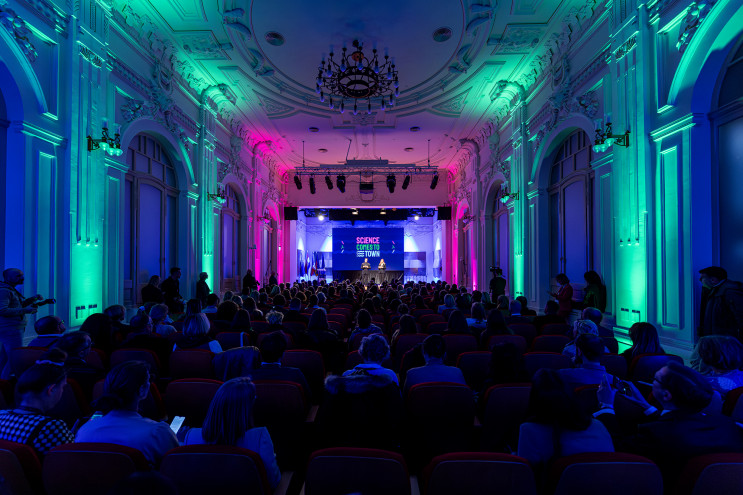
The international, EU-funded Science Comes to Town project was officially opened in Split yesterday (20. January 2026), aiming to bring science closer to citizens through public events, educational programmes and interactive content. The project connects the cities and regions of Split, Kiel and Brest, as well as a network of more than 70 European institutions, strengthening the role of cities as key spaces for the exchange of knowledge, innovation and the active participation of citizens in scientific and social processes.
The opening of the project brought together numerous local and international representatives of institutions, the scientific community and government. The event was hosted by the City of Split, the University of Split, the Institute of Oceanography and Fisheries and the Centre of Excellence of the Split-Dalmatia County, in cooperation with international partners.
Science in the Heart of the City: Leadership and Vision
The programme began with an international conference at the Croatian House, where participants were addressed by Ivo Bilić, Deputy Mayor of the City of Split; Bettina Aust, President of the City Council of the City of Kiel; Sandrine Perhirin, Vice President of Brest Métropole for Higher Education and Research; Prof. Dr Sc Dragan Ljutić, Rector of the University of Split; and Radovan Fuchs, Minister of Science, Education and Youth of the Republic of Croatia.
Deputy Mayor Ivo Bilić emphasised the importance of bringing science out of the laboratory and into public spaces, highlighting the sea, water, and cultural and historical heritage as overarching themes of the project, as well as the key role of young talents in the future development of the community. Boris Jokić, Director of the Institute for Social Research in Zagreb, also spoke about the importance of the accessibility of science, stressing that science must be present on streets, squares, in schools and in families, as the foundation for critical thinking and the fight against disinformation.
“This is an exceptional event. You can see first-hand the place occupied by our science, our university and our city. Among ten associations, we, together with Kiel and Brest, were selected as the European Capital of Science,” said Prof. Dr Sc Dragan Ljutić, Rector of the University of Split.
“This is a wonderful event and I believe it is very important for the popularisation of science in general. Science and research are needed not only in Croatia, but throughout Europe. They drive national economies, and without this knowledge we cannot imagine the future. The project will last two years, with six million euros available. I expect excellent results, not only for the city of Split,” emphasised Minister Radovan Fuchs.
Sandrine Perhirin, Vice President of Brest Métropole for Higher Education and Research, added that one thousand events will be organised over 365 days, enabling all citizens of Brest, Kiel and Split to engage more closely with science, develop critical thinking skills and combat disinformation.
“This is a great project of the European Union, which not only promotes a deeper understanding between science and society, but also strengthens cooperation within the European Union in these challenging times,” concluded Ulrike Wielatt, Managing Director of KielRegion. "I am proud that Kiel and the KielRegion are part of this network and, together with the cities and regions of Brest and Split, promote exchange between research, innovation and society across Europe," added Bettina Aust, President of the Cities Council of the City of Kiel.
Engaging Citizens Through Dialogue, Exhibitions and Culture
As part of the conference, panel discussions were held on the topics Cities at the Centre of Science and Society and Cultural Economy: Connecting Science and Society, alongside an interactive workshop entitled Science4Future, Future4Science, focusing on the future of science and its role in societal development.
In the afternoon, an interactive exhibition intended for the general public was opened in Diocletian’s Cellars, attracting great interest from visitors. The exhibition is open from 20 to 24 January 2026, daily from 10:00 to 14:00.
The exhibition programme includes the following thematic units: Nikola Tesla – The Man Who Enlightened the World (Nikola Tesla Technical Museum, Zagreb), Peaks of the Depths – The Underwater Heritage of the Split-Dalmatia County (Maritime Museum Split), The Mysterious Life in a Drop of Sea (Institute of Oceanography and Fisheries), and Portraits of French Scientists (Alliance Française Split).
On the same day, an exhibition of portraits of French scientists entitled Poissonnerie scientifique was opened at the Alliance Française de Split, in the presence of the French Ambassador, H.E. Fabien Fieschi, and Deputy Mayor Matea Dorčić.
Science Comes to Town represents a significant step forward in the popularisation of science and the strengthening of connections between the scientific community and citizens, confirming Split as one of the European capitals of science and innovation.