How one Croatian researcher is fostering broader understanding of marine conservation
By Timothy Spence
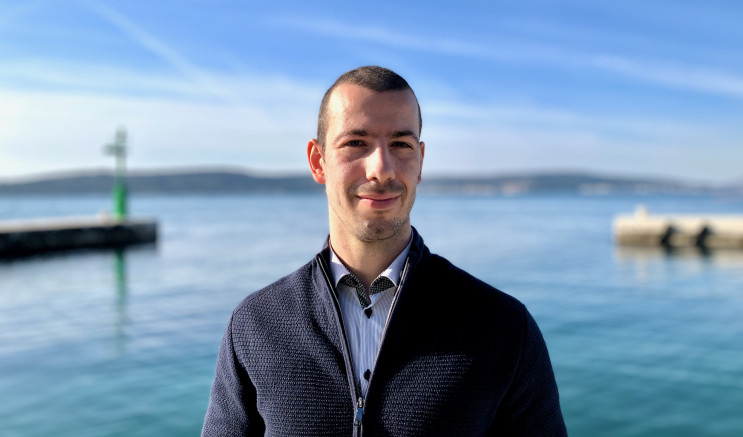
As he enters a laboratory with saltwater pools full of fish, Luka Žuvić explains how climate change is affecting the feeding ecology and reproductive biology of Atlantic bluefin tuna, and how the species is adapting.
It is a topic that may seem remote to many people. But in a country where fishing and aquaculture are important to the economy and national identity, Žuvić’s research is at the intersection of science and society. “In Croatia, marine and environmental science are closely connected to people’s lives because fisheries, aquaculture, tourism and coastal development are a big part of our lives,” explains Žuvić, a doctoral student working at the Croatian Institute of Oceanography and Fisheries in the Adriatic coastal city of Split.
He also serves as one of Croatia’s ambassadors to Science Comes to Town (SCTT), a European Commission-funded project that aims to make scientific research more accessible, while inspiring young people to study the sciences. The project kicked off in Spilt on 20 January with a conference attended by partner institutions, community representatives, policymakers and scientists. Along with Split, Brest (in France) and Kiel (in Germany) will host a year of activities connecting scientists with the public.
Žuvić, 31, is part of the Young Researchers' Career Development Project, a doctoral programme funded by the Croatian Science Foundation. His research on Atlantic bluefin tuna builds on a foundation-backed project focusing on the reproductive potential of farmed tuna, including their sexual maturation and spontaneous spawning in captivity, which has implications for the restoration of the Adriatic Sea's natural tuna populations. He also studies the tuna's feeding ecology through stomach-content analysis, using DNA metabarcoding and morphological approaches, and employs geometric morphometrics to improve the identification of juvenile tuna and related species. The research aims to enhance understanding of the tuna farming ecology, improve fish farm management and contribute to sustainable aquaculture and fisheries research.
Engaging with local communities
Connecting with the community is crucial for Žuvić’s research. Conversations with fishermen help him better understand the bluefin tuna's habits and how marine pollution affects the fish. “They are also curious about the biology and ecology of bluefin tuna,” he says of local fishermen, adding that sharing research with non-scientists benefits everyone. “Sometimes scientific research is invisible,” he explains. “That's why we as researchers need to go out from our institutions and labs to the public so that we can show them what we are working on. This helps create more trust in the scientists and their research.”
Engaging the public also raises awareness about the anthropogenic changes to the marine environment resulting from human activities and pollution. Žuvić helps remove plastic and other rubbish from the Adriatic Sea that pose a direct threat to marine species. Predators, such as bluefin tuna, are especially vulnerable to ingesting waste churned up by fishing trawlers. “They are very opportunistic fish that follow trawlers and ingest everything,” he notes. To illustrate the impact, he has shown students the contents of bluefin tuna stomachs. “Finding a plastic bottle cap in the stomach of a bluefin tuna is concerning,” he says. "Science can be a powerful way to turn curiosity into practical solutions,” Žuvić adds, and sharing research outcomes “helps increase public awareness and improve understanding of human impacts on the marine environment.”
The research also has implications for Croatia's economy. The Atlantic bluefin tuna’s rich, flavourful meat is highly valued for sushi and other raw fish dishes. However, overfishing nearly brought its population to collapse by the early 2000s. Although the species has made a comeback in the Atlantic and Mediterranean regions, catches continue to be managed through agreements with the International Commission for the Conservation of Atlantic Tunas. Croatia was a pioneer in developing commercial aquaculture as an alternative to open-sea fishing and accounts for about 10% of the EU’s farmed production of the bluefin tuna, with Japan being a key export market.
A history of European collaboration
Croatia has participated in Europe’s framework programmes for research and innovation since 2007, six years before officially joining the EU. Žuvić believes that EU funding and collaboration with other European researchers is vital for Croatian science. As part of the SCTT opening conference, the Institute of Oceanography and Fisheries, the University of Split and other local institutions were part of a science fair to showcase research on topics, such as robotics and an EU LIFE project on the protection of sharks and rays in the Mediterranean.
“I hope that Science Comes to Town will help increase scientific literacy and curiosity among citizens, particularly students, and show that science is not something that is distant or abstract, but something that directly affects everyday life,” Žuvić concludes. “Ultimately, I hope that projects like it contribute to building a society that values knowledge and critical thinking, and that we can think about long-term sustainability using knowledge from science.”
Science|Business, which connects policymakers, academics and industry through its news reporting, analysis and events, is an SCTT partner.