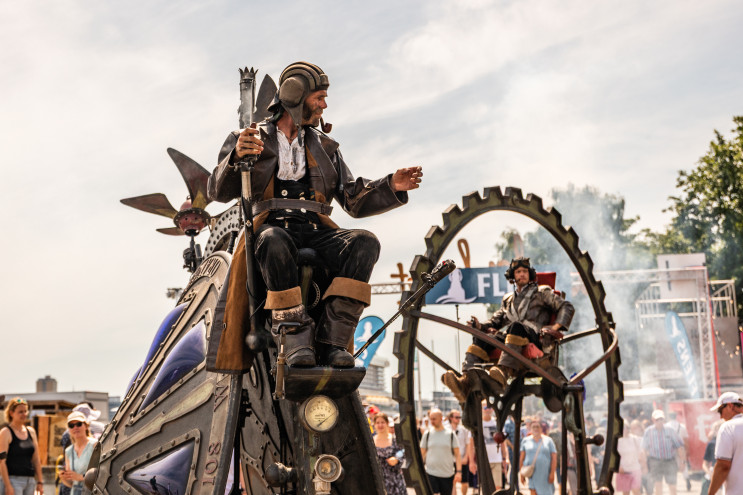
Hands-on science across the whole city: a city rally with 22 stations, a steampunk parade on the Kiellinie and more than 700 hours of programme. With these, the EU project Science Comes to Town brought research to the heart of Kiel Week 2026.
At Kiel Week 2026, science wasn't tucked away in one corner. It was almost everywhere. From 20 to 28 June, the EU-funded project Science Comes to Town worked with research institutions from Kiel and the surrounding region to bring research to the event areas. The programme stretched from the City Hall stage and the Spiellinie children's area to the Blaupark in the Gaarden district. In total, it offered more than 700 hours of science. Under the motto "Kiel Week connects", it showed how curiosity brings people together.
City rally: 28 questions that spark curiosity
At the centre of the programme was an interactive city rally at 22 places. The information pillars stood on Kiel Week sites all the way from Rathausplatz, the square in front of City Hall, to Schilksee. Each station posed a surprising everyday question, such as "Why are there sometimes so many jellyfish in the Kiel Fjord in summer?" or "Were there patchwork families in the Stone Age?" A QR code took visitors straight to the answer, with no app or registration needed. They also got to know Kiel researchers and their work, and found out how to take part in citizen science projects themselves. The topics ranged from the sea to antiquity.
Everyone was invited to join in. Kiel Week visitors could share their own wishes for science and their visions of the future online. What Kiel wants from research was shown on the big screens at the City Hall stage, among other places.
Children had their own rally. With a postcard from the info point in the SEALEVEL area or from the Schlaumachwiese, a meadow full of activities for children, young researchers set off to explore. At each pillar, they found a section of a picture that they could copy onto their card. Put together, the pieces formed a mystery animal. Anyone who found it received a small reward.
Steampunk on the Kiellinie
On the first Kiel Week weekend, science rolled down the waterfront promenade, quite literally. In the Steamroadster Parade by Abacus Theater, four elaborately designed steampunk vehicles drove along the Kiellinie on 20 and 21 June, four times on each day. With music, smoke, water and fire, the machines looked like inventions from another age. The parade combined street theatre and technology and turned the Kiellinie into a stage for inventive spirit.
From research vessel to Babbel Bubble
The rest of the programme was just as varied. In a large "Babbel Bubble", people talked openly about the energy transition. Start-ups showed how curiosity turns into real solutions. Science shows, a chemistry show, film screenings, readings, a pub quiz and a research passport combined research with entertainment. At "kieler uni live", the hands-on area run by Kiel University (CAU), the "Bachelor of KiWo" was awarded more than 1,000 times. On 26 June, the GEOMAR Helmholtz Centre for Ocean Research Kiel also opened its research vessel ALKOR to visitors.
Science was also the focus at international level. At the International Cities Forum on 20 June, delegations from ten of Kiel's partner cities met at Förde Sparkasse. The theme was "Science as a driving force for innovative urban societies".
What comes next
Kiel Week was far from the end of the science year. Until the end of 2026, Science Comes to Town will bring more than 1,000 events to the heart of city life in Kiel, Brest and Split. All dates are available at www.sctt-kiel.de.