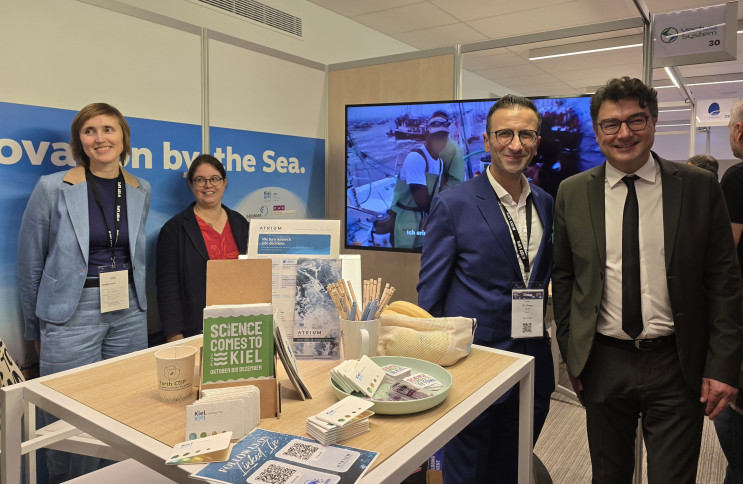
New momentum for the city partnership and promising new connections in the maritime economy and research: Kiel's delegation, led by Lord Mayor Samet Yilmaz, has returned from its visit to the French partner city of Brest with a strong set of tangible results.
The visit highlighted just how much the two port, naval and university cities have in common and how many opportunities this shared profile creates for future joint projects.
A key focus of the visit was the exchange between Lord Mayor Samet Yilmaz and his Brest counterpart, Stéphane Roudaut, who also took office this spring. Both agreed that the partnership, which has existed since 1964, should evolve and become more visible and meaningful for people in both cities, with a particular focus on younger generations.
Existing cooperation in school and university exchanges, education, science, culture and sport will be expanded. New opportunities are also emerging in marine research, maritime security and dual-use technologies with both civilian and military applications.
“For more than 60 years, Kiel and Brest have shared a vibrant friendship. We want to build on this strong foundation and give our partnership fresh momentum,” said Lord Mayor Samet Yilmaz.
“This visit clearly demonstrated how much our cities have in common and how much potential our cooperation holds. Now the task is to make this partnership more visible and tangible for people in both Brest and Kiel. Science Comes to Town showed what is possible when we bring science and people together across borders. We want that spirit to continue by connecting young people more closely, strengthening our position as leading maritime science and innovation hubs, and turning valuable contacts into concrete joint projects.”
Brest's Mayor Stéphane Roudaut also emphasised the importance of the long-standing relationship:
“For me, the partnership between Brest and Kiel is above all about friendship. Our relationship is built on a shared commitment to economic development, higher education and marine research. It is this strong friendship that we must continue to nurture and strengthen.”
Kiel showcases maritime innovation at Sea Tech Week
The scale of the cities' shared potential became particularly clear during the international Sea Tech Week conference, where Kiel presented itself on a larger scale than ever before as a centre for maritime innovation.
A joint exhibition stand organised together with Kiel's economic development agency KiWi gave companies and institutions from Kiel a platform to showcase their expertise and establish international contacts. Participants described the initiative as a clear success.
Kiel's delegation also contributed to the conference programme. Jörg Demuth, Managing Director of Port of Kiel, joined international port leaders on the high-level Ports of the Future panel to discuss the future of European ports. A subsequent tour of the Port of Brest provided further insights into developments at the French harbour.
“Sea Tech Week demonstrated the enormous potential of international cooperation in the maritime economy,” said Demuth. “It gave us an excellent opportunity to present Kiel as an innovative port, build new partnerships and gain valuable inspiration for shaping the ports of tomorrow.”
For more than 25 years, Sea Tech Week has brought together the international maritime community in Brest. This year's event once again strengthened connections between industry, science and research, while highlighting the remarkable similarities between Kiel and Brest. Both cities combine world-class maritime research, innovative businesses and growing expertise in security-related technologies.
Dr Julia Körner, Managing Director of the Kiel Chamber of Commerce and Industry, said:
“I was particularly struck by how similarly Kiel and Brest are positioned when it comes to the future of the maritime sector. Both locations combine economic strength with outstanding research and emerging security technologies. We should now build on the momentum of this visit: making contacts is an important first step, but our shared goal must be to turn them into lasting cooperation and joint projects.”
Dr Barbara Weig from Kiel's economic development agency added:
“Our joint exhibition stand was a great success. Numerous international visitors learned about Kiel as a maritime innovation hub and connected directly with members of our delegation.”
Science strengthens the Kiel–Brest connection
Scientific cooperation formed another key pillar of the visit. Universities and research institutions in both cities already share extensive partnerships, including between Kiel University (CAU) and the Université de Bretagne Occidentale (UBO), Kiel University of Applied Sciences (HAW Kiel) and ENIB engineering school, as well as between GEOMAR Helmholtz Centre for Ocean Research Kiel and the French marine research institute Ifremer.
These established networks provide a strong foundation for developing future research and knowledge-transfer projects.
“Protecting our oceans and strengthening maritime security are cross-cutting challenges that require business, politics, public administration and science to work together,” said HAW Vice President Professor Tobias Hochscherf. “Looking beyond the borders of our own city and country is essential for researchers. Our close relationship with Brest creates excellent opportunities for joint projects, exchange programmes and shared events.”
Dr Johannes Karstensen of GEOMAR added:
“Our scientific cooperation with Ifremer has created close ties with Brest over many years, and we are delighted to contribute these connections to the city partnership.”
A particularly strong link between the cities this year is the European project Science Comes to Town, which brings together Kiel, Brest and Split (Croatia) as European Science Ambassadors for 2026. The initiative aims to bring science closer to communities and make research accessible to people of all ages.
One example of this approach was the delegation's visit to Océanolab at Brest's Océanopolis science centre, where visitors can experience scientific experiments first-hand and explore the impacts of climate change on marine ecosystems.
A Kiel success story is also inspiring Brest: the Children's University programme will be introduced there for the first time. During the visit, project teams exchanged experiences and explored ideas for continuing their collaboration beyond the official end of Science Comes to Town. In 2027, another of Kiel's partner cities, Aarhus, will carry the European science title forward.
Katharina Sommer from Kiel University's International Center said:
“Kiel University and UBO have connected students, doctoral researchers and academics through exchanges for decades. It was inspiring to see how these relationships extend into the wider community and how ideas continue to grow across generations.”
Fresh inspiration for urban development
Alongside business and science, the visit also offered valuable inspiration for urban development. One particular highlight was the visit to Ateliers des Capucins, a former industrial site that has been transformed into a vibrant public space combining culture, creativity, work and leisure.
The integration of modern transport solutions such as trams and cable cars also provided valuable ideas for future urban mobility.
The visit concluded with more than a positive balance sheet. It established a clear roadmap for future cooperation: newly forged contacts will be deepened, existing partnerships strengthened and shared project ideas pursued further. The delegation's visit demonstrated that the friendship between Kiel and Brest is not only rooted in a rich history but also holds tremendous promise for the future.
Delegation members
The Lord Mayor's delegation included representatives from:
- GEOMAR Helmholtz Centre for Ocean Research Kiel
- Kiel University (CAU)
- Kiel University of Applied Sciences (HAW Kiel)
- Kiel Chamber of Commerce and Industry
- Port of Kiel
- Kiel Science Center
All participants covered their own travel costs. Additional companies and institutions from Kiel also took part independently in Sea Tech Week.
About Sea Tech Week
Sea Tech Week Brest is a biennial international conference dedicated to maritime research, technology and innovation. It brings together researchers, industry leaders, start-ups and policymakers from around the world to exchange knowledge, showcase innovations and foster collaboration across the maritime ecosystem.
The programme includes conferences, exhibitions, workshops and networking opportunities. Exhibitors range from research organisations, start-ups and multinational companies to SMEs, maritime clusters, universities and NGOs. Around 1,000 participants from 20 countries attended this year's edition.
About Science Comes to Town
In 2026, Kiel, Brest and Split will serve as Europe's Science Ambassadors. Science Comes to Town brings research directly into cities, communities and neighbourhoods through a year-long programme of public events organised by more than 70 European organisations, making science accessible and engaging for people of all ages.