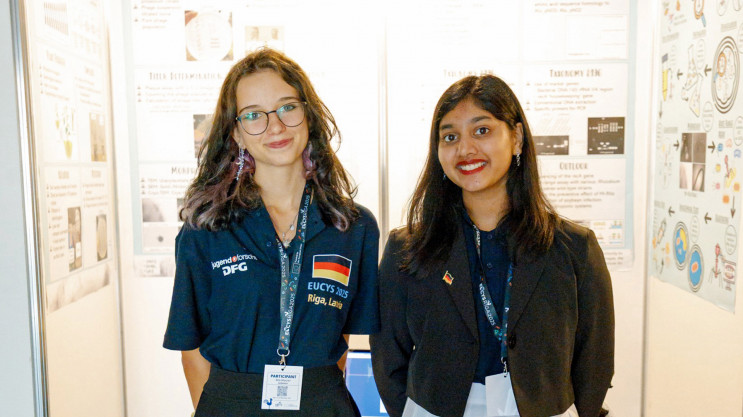
A demanding research project run by two German high school students points to how science can capture the imagination of young people
After spending many long days conducting experiments to find a new way to combat bacterial infections in crops, Misha Hegde and Mia Soleil Maurer have been rewarded with international recognition and access to top research facilities. But these are not typical scientists. They are 16-year-old German high school students.
“Our supervisor told us that in order to start a project, you need to begin with either a question or a problem,” says Misha, adding that she and Mia had read about antibiotic resistance in certain plants being treated for bacterial infections. “We found out that antibiotics overuse is very common in agriculture,” explains Mia. “Our aim was to create an alternative to antibiotics and to try to raise awareness of the problem of overusing antibiotics.”
Their subsequent research has focused on harnessing bacteriophages, the natural predators of bacteria, to eliminate pathogens threatening food crops treated with antibiotics. At the Schuldorf Bergstraße Jugend forscht MakerLab in Seeheim-Jugenheim, located in the German state of Hesse, they discovered a novel phage that infects the Rhizobium rhizogenes bacterium, which causes the hairy root disease that can reduce yields of tomatoes, carrots, soya beans and other food staples.
The students believe their method could curb antibiotic use, while protecting plants from infections without disturbing the natural soil microbiome. “The application of phages is host-specific, so they would only kill the targeted pathogen or disease-causing bacteria,” explains Mia. It may also offer environmental benefits, since applying antibiotics can contaminate groundwater.
Getting to this point has not been easy. The childhood friends admit to feeling frustrated when their trials did not yield the expected results. “We spent six months on our first experiment, just doing the same thing over and over and over again, to the point where we thought, is it even worth it? Why are we doing this?” Misha says. “You just need to be brave enough to take that first step and keep going.”
The benefits of inquiry-based learning
Their determination has paid off. In 2025, the pair won first prize in biology at Jugend forscht, Germany’s national competition for young people interested in science, technology, engineering and mathematics. They were also among the winners of the German Research Foundation Europa-Preis, which is awarded to selected national winners at Jugend forscht, and took third place in the 2025 European Union Contest for Young Scientists.
The Jugend forscht Foundation opens doors for young people to connect with scientists as well as industry professionals. Jessica Bönsch, executive director of the Foundation, sees Misha and Mia as prime examples of how young people can develop a deeper understanding of science through their own research projects. “The experience of working on your own research question is very important,” she explains, adding that “inquiry-based learning engages with real-life problems in a way that can be more motivating than traditional classroom teaching.”
The Jugend forscht Foundation offers financial support through sponsor pools in Germany’s federal states. Some projects are developed in cooperation with student research centres, university labs or informal collaborative learning areas called makerspaces. Other activities start as hands-on “garage projects” and can grow within the Jugend forscht network and infrastructure.
The Jugend forscht Foundation is also a partner of Science Comes to Town, an EU initiative to strengthen public awareness about science and create bridges between researchers and communities. The EU-financed project involves universities, research institutions and other stakeholders in three host cities — Brest (France), Kiel (Germany) and Split (Croatia).
“It's so important for people not to live in a bubble, because I think science can be very scary if you misunderstand it,” Mia says of SCTT. The initiative’s aim of raising awareness about science is “absolutely amazing,” Misha adds. “I think it's the best way to kind of make science digestible for the public. In a world where misinformation in science is getting more radical, more dangerous, becoming more of a threat to the trust in scientific infrastructure and foundations, we need such programmes.”
Misha and Mia also believe that SCTT can help break down gender stereotypes in science by encouraging young women to study and pursue careers in scientific fields. Both students have benefited from female mentors and encouragement they had when they were much younger. Mia’s love of science began with a class trip to a lab, while Misha — with a smile on her face — says she wanted to study history until “a teacher kind of coerced me into joining a school science club.”
Recognition beyond Europe
In May, Misha and Mia were among the finalists at the Regeneron International Science and Engineering Fair held in Phoenix, Arizona, and involving nearly 1,700 pre-university students from over 60 countries. “It was very crazy because there were so many people and so many teenagers interested in science,” Mia recalls. The event was also challenging. “It was eight hours of continuously presenting your project,” adds Misha.
Attending the fair was a chance for the young women to see first-hand the value of international collaboration as well as how research cultures differ. “America is a bit more willing to take risks, and I think that's something we can learn about here in Europe,” Misha explains. However, she continues, “I think Europe has the talent, has the innovation and has the resources” to be competitive.
Misha and Mia plan to continue their phage experiments in the new school year, inspired by the project’s hands-on nature and the support they receive from their supervisors. They have also attracted the interest of professional scientists and received invitations to leading research facilities, including the Centre for Synthetic Microbiology, jointly run by the University of Marburg and the Max Planck Institute for Terrestrial Microbiology in Germany. “It is so cool that we can do something to try to move the world in our school and at this age,” Mia says.
After completing secondary school, Mia plans to study microbiology and pursue a career in medical research, focusing on Ebola and other infectious diseases. “This has been my dream for so long,” she says. Her friend Misha is interested in biological research with a focus on medicine. “I've gotten addicted to the process of going to the lab, planning out experiments, then failing, trying again,” Misha says. “I think there's just so much to be discovered, so much to be done.”
The students' names and photos were published with the permission of their parents.
Science|Business, which connects policymakers, academics and industry through its news reporting, analysis and events, is an SCTT partner. Visit the original article.