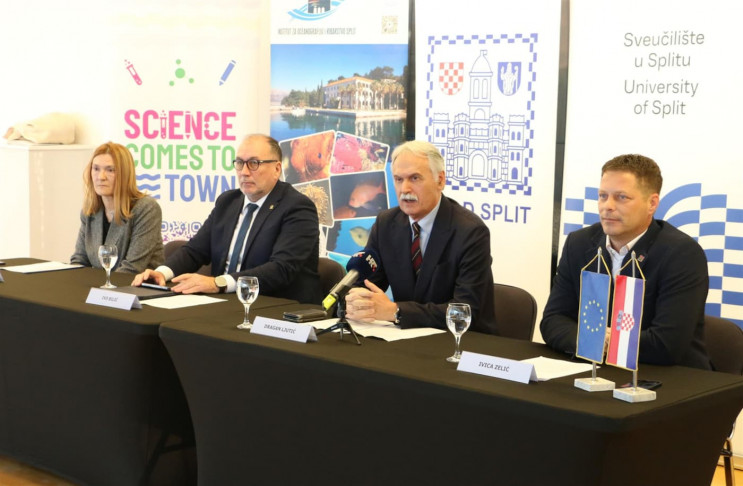
A press conference was held on Thursday, January 16th, at the University Gallery in Split to announce the grand opening of the international project Science Comes to Town, which will be held on January 20, 2026, at the Croatian House and Diocletian's Cellars in Split.
Science Comes to Town is an international project funded by the Horizon Europe programme, which aims to connect science and citizens through a year of public events and interactive activities in three European cities – Split, Kiel, and Brest. Through more than a thousand activities, involving more than 70 partners, the participating cities will become living laboratories and meeting places for science and citizens. The programme includes festivals, workshops, discussions, and various creative formats, and more than 1.5 million citizens are expected to participate.
Voices from the City, Science, and Education
The Rector of the University of Split, Prof. Dr. Sc. Dragan Ljutić, pointed out that the project represents exceptional recognition for the city and the university community. "Split and the University of Split are today the European capital of science. The project enables the connection of cities and universities, opens up opportunities for youth employment, and promotes science from the youngest to the entire community. We are particularly pleased that we will host the Nobel laureate John Martinis in July, which is a source of pride for Split and the University," said Rector Ljutić.
Deputy Mayor of Split, Ivo Bilić, stressed the wider social and developmental significance of the project: “The aim of the project is to bring science closer to citizens. Split is becoming the European Capital of Science this year, and events like this open up a new niche in scientific tourism that we will use in the future development and promotion of the city. The city recognizes the importance of investing in the future, young talents, and excellent scientists.”
The Director of the Institute of Oceanography and Fisheries, Živana Ninčević Gladan, warned about the importance of strengthening public trust in science. "Trust in science is declining, and our goal is to bring research closer to citizens. The sea and water are at the heart of our work—from microalgae and corals, to past-revealing shellfish, and the impact man-made sound has on sea life. We are particularly excited about the planned activities in 2026, such as the Children's University and Citizen Science, in which citizens will actively participate in collecting and analyzing scientific data," Ninčević Gladan emphasized.
The role of education and youth
The role of education and youth was discussed by the Director of the Center of Excellence of Split-Dalmatia County, Ivica Zelić. "I am proud that at this moment we can say that we have put Split and our county on the map of Europe as an environment that is continuously developing into a place of exceptional quality of life. The Center of Excellence plays an important role as a bridge between primary and secondary education and universities. Through this project, we encourage children and young people to be innovative, creative, and work as a team, and in addition to activities for citizens and the general public, for the first time we are organizing a Science Battle—an innovative format that brings science closer to a wider audience through interactive workshops," said Zelić.
After the conference at the Croatian House, science symbolically moves among the citizens—to Diocletian's Cellars—where visitors will be welcomed by the exhibition "Nikola Tesla – The Man Who Enlightened the World" from the Technical Museum "Nikola Tesla" in Zagreb, the multimedia exhibition "Peaks of the Depths – Underwater Heritage of Split-Dalmatia County", the exhibition of the Institute of Oceanography and Fisheries, "Mysterious Life in a Drop of the Sea", as well as the accompanying exhibition "Portraits of French Scientists" at Alliance Française Split.
Until January 24, citizens can expect a rich programme of interactive activities—from virtual reality and underwater exploration to workshops for children and families, and talks with scientists and students. The programme focuses on topics of the sea, the environment, sustainable development, and new technologies, confirming Split as one of the European centres of science and society.